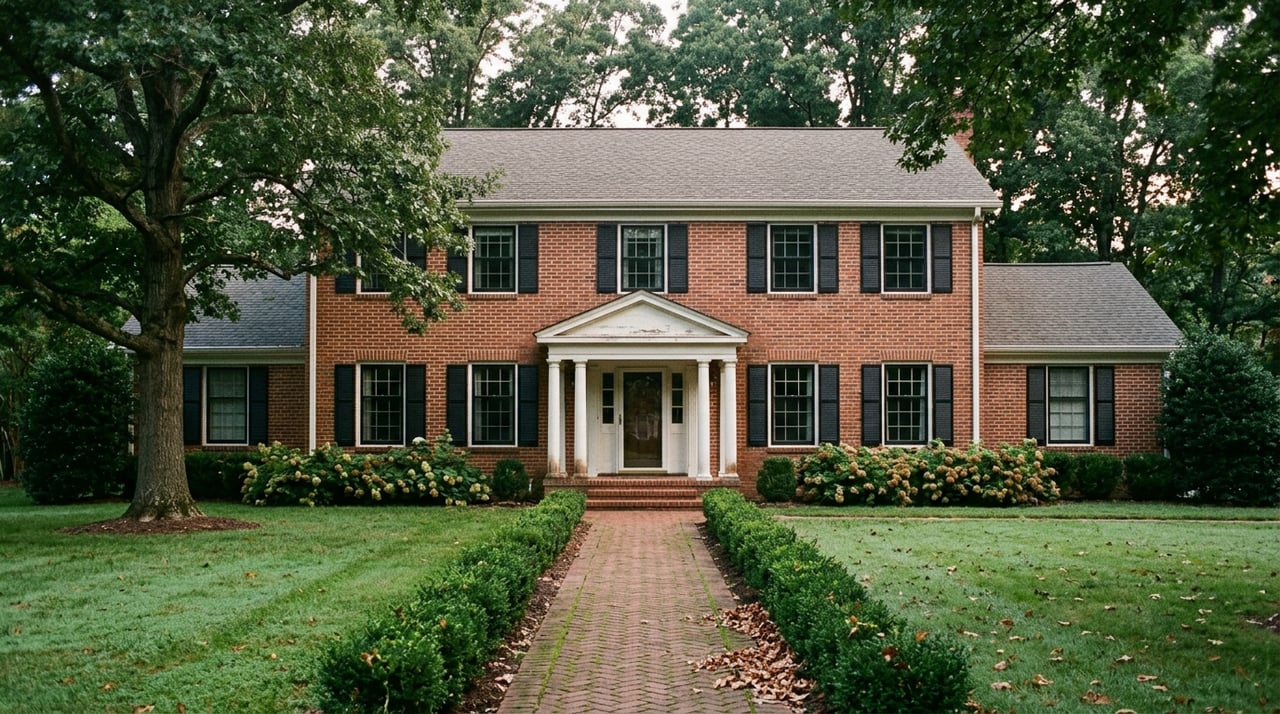
Drive Bridle Lane on a Tuesday afternoon and nothing about it looks unusual. It is a quiet residential street in Frontenac, lined with the kind of one-acre lots and mature trees that define this part of St. Louis County. A block over sits Countryside Lane, another name that reads as scenery rather than history. Most people who live here have driven these streets thousands of times without asking why a landlocked St. Louis suburb has street names that belong to a fox hunt.
The answer is not decorative. Frontenac's equestrian street names are a literal map. They mark where working stables once stood and where the trails that connected them actually went, and one of those trails ended at the exact spot where shoppers now park to walk into Plaza Frontenac.
The Stables That Gave the Streets Their Names
Frontenac was incorporated as a city of the fourth class on November 6, 1950, not long after a 1948 annexation added roughly 967 acres to the young community, including land that would later become West End Park and the Ballantrae subdivision. The terrain that came with that annexation, rolling hills and heavy woods, made the area a natural draw for horse people in the decades that followed.
From the 1950s into the 1980s, Frontenac was home to several family-run stables. The Otis Brown Stables operated on Countryside Lane. On Bridle Lane, riders kept horses at both the Palmer Stables and the Clayton Hunt Club. These were not boutique names chosen by a developer decades later. They were working operations, and the streets carrying their names today are the same streets those stables sat on.
The subdivisions built near Geyer Road in the years since still carry that inheritance. Many of the neighborhood and street names in that corridor reference equestrian life, fox hunting, and the English countryside aesthetic that went with it, a naming convention the city itself traces directly back to the stable era rather than to later marketing.
Where the Trails Actually Went
Here is the detail that turns this from a naming curiosity into an actual map. The horse trails that ran out from the stables on Bridle Lane and Countryside Lane did not just loop through backyards. They extended along the area surrounding Geyer Road and continued to land that is now the site of Plaza Frontenac.
That is worth sitting with for a moment. The mall most Frontenac residents drive to for dinner or a gift now sits on ground that was, within living memory for some longtime residents, a destination reached by trail from a stable a mile or two away.
The connection gets sharper once you look at what was happening on that same patch of ground even earlier. Neighboring Huntleigh, the small equestrian village just southwest of Frontenac, was home to the Bridlespur Hunt, a fox-hunting club founded in 1927 by Edward Bakewell and August A. Busch Sr. According to Huntleigh's own history of the club, members of that hunt later laid out a steeplechase course on the ground where Plaza Frontenac now stands. The horses that once cleared jumps on that property have been replaced by shoppers circling for a parking spot, but the ground itself did not move.
The Same Corridor, Doing a Different Job
The trail network is gone. Geyer Road is not. And right now, as of this September, the road is in the middle of a construction project that has nothing to do with horses and everything to do with getting kids to school safely.
The City of Frontenac has worked with the East-West Gateway Council of Governments and the Missouri Department of Transportation to secure federal funding for the Geyer Road Revitalization Project, framed by the city as a public safety and safe-routes-to-school effort. PCX Construction was selected as low bidder, and the city has been working through the required pre-construction steps with the Lochmueller Group before crews move ahead. The plan calls for a new signalized pedestrian crossing at Geyer Road, with the sidewalk continuing south to Hermitage Hill Road. The city has said the work will push through winter as conditions allow, with a spring or early-summer completion in view.
It is a small irony worth naming without overstating it. The corridor that once carried hoofbeats toward a hunt club's steeplechase course is now getting a signal-controlled crosswalk so that children can walk to school on foot. Same road, same rough geography, an entirely different kind of traffic being planned for.
A Reason to Be Out on It This Fall
None of this history requires a special trip to appreciate. It is worth knowing the next time you're waiting at a red light on Geyer Road, or explaining to a new neighbor why their subdivision is called something that sounds like it belongs on a hunting print.
If you want a reason to be outside in Frontenac this season, the Frontenac Fall Festival is scheduled for October 9, from 5 to 8 p.m. at Frontenac City Hall on Clayton Road. The Town & Country-Frontenac Chamber of Commerce is expecting a large turnout for an evening built around live music, food, and the kind of low-key community mixing that doesn't need a theme beyond the season changing. It is not a festival about horses or history. It is simply an evening on the same ground where, longer ago than most current residents remember, a working trail network once connected a handful of family stables to land that would eventually become one of the region's best-known shopping destinations.
That is the part of Frontenac's story that tends to get lost in real estate listings and city brochures alike. The equestrian names on your street sign are not branding. They are the last visible trace of an actual working landscape, one that got paved, developed, and eventually replaced, but never fully erased. Bridle Lane still runs where Bridle Lane always ran. It just doesn't carry the traffic it used to.
Understanding a neighborhood at this level, the history under the pavement and not just the price per square foot, is the kind of work we do for every client who walks through our door, whether they are restoring a historic property or simply trying to understand what makes a street worth calling home. If you are curious about what your own corner of the Central Corridor has been quietly holding onto, the team at The Warner Hall Group would welcome the conversation. Request a private consultation and let's talk about what your neighborhood's history actually means for its future.